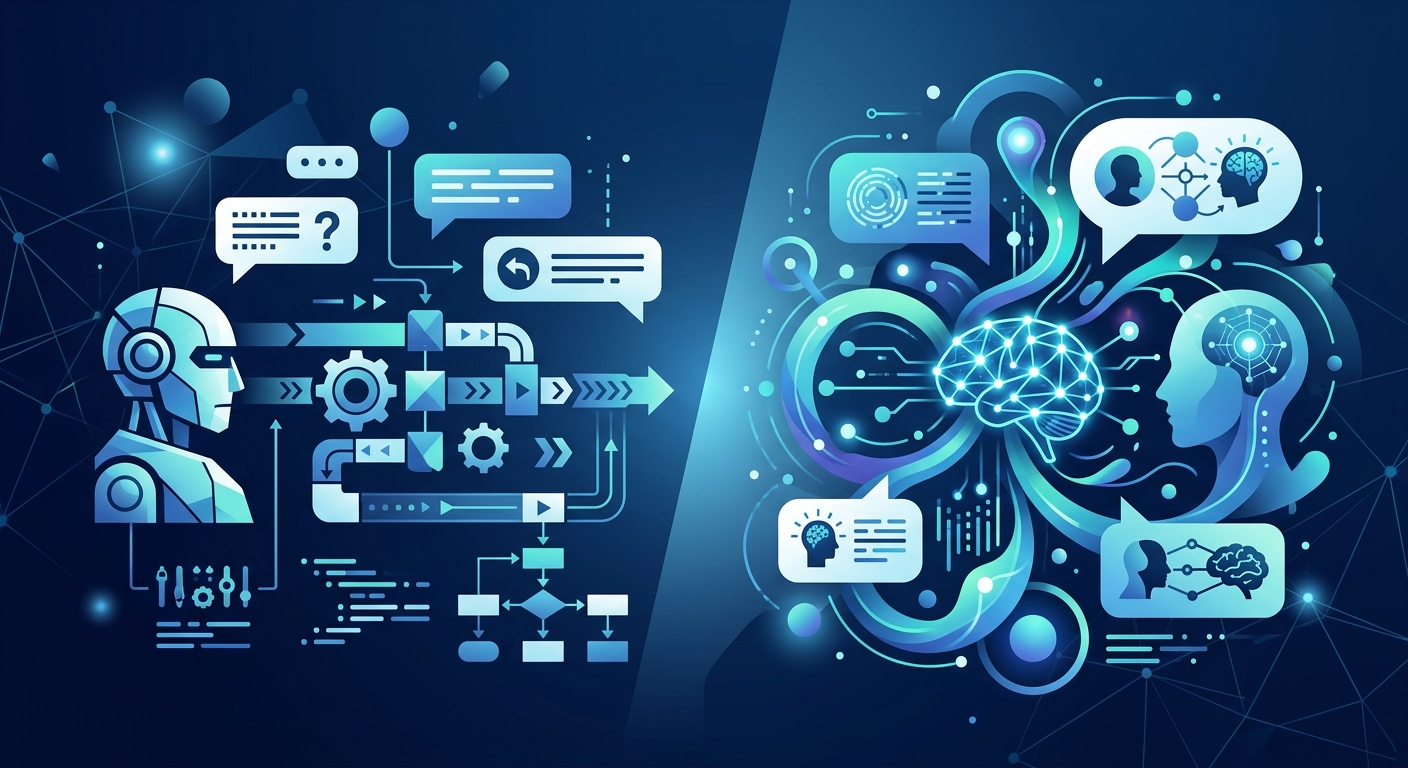
In the modern enterprise landscape, the terms "chatbot" and "conversational AI" are frequently used interchangeably, yet they represent fundamentally different levels of technical sophistication and utility. Understanding the difference between chatbot and conversational AI is no longer a matter of semantics; it is a strategic necessity for leaders navigating the Agentic Enterprise. While a chatbot is a specific interface designed to simulate dialogue, conversational AI is the underlying technological engine—the "brain"—that allows machines to understand, process, and respond to human language with contextual nuance.
Following the COVID-19 pandemic, 52% of companies increased their adoption of automation and conversational interfaces to meet rising demand Yellow.ai. This surge has highlighted the limitations of legacy systems. Traditional chatbots often rely on rigid, pre-defined scripts, whereas conversational AI uses Natural Language Processing (NLP) and Machine Learning (ML) to handle unstructured inputs. This article provides a comprehensive deep dive into these technologies, helping you determine which solution aligns with your organizational goals.
Key Takeaways
- Definition: A chatbot is a specific user interface (UI), while conversational AI is the set of technologies (NLP, ML, NLU) that powers sophisticated interactions.
- Logic: Traditional chatbots are rule-based and follow "if-then" decision trees; conversational AI uses intent recognition to understand context.
- Scalability: Conversational AI improves over time through machine learning, whereas rule-based chatbots require manual updates for every new scenario.
- Adoption: Over half of enterprises accelerated their conversational automation investments post-2020 to manage increased digital volume Dimension Labs.
What is a Chatbot? Understanding Rule-Based Logic
A chatbot is a software application designed to mimic human conversation through text or voice interactions. According to Stanford Teaching Commons, AI chatbots benefit users by increasing efficiency and reducing the drudgery of reading and writing tasks. However, not all chatbots are created equal.
The most basic form is the rule-based chatbot. These systems operate on a decision-tree model. If a user selects "Option A," the bot provides "Response A." These are well suited for simple, repetitive tasks such as checking an order status or answering frequently asked questions (FAQs). However, they cannot deviate from their programmed path. If a user asks a question the developer did not anticipate, the bot typically fails, often resulting in the frustrating "I'm sorry, I didn't understand that" loop.
What is Conversational AI? The Engine of Intelligence
Conversational AI is a technology framework that enables computers to engage in natural, human-like dialogue. Unlike a simple chatbot, conversational AI is not a single tool but a combination of several disciplines, including Natural Language Processing (NLP), Natural Language Understanding (NLU), and Machine Learning (ML).
As noted in PMC - NIH, intelligent agents are software programs that perform a variety of tasks ranging from routine work to sophisticated operations. Conversational AI serves as the intelligence layer for these agents. It allows the system to:
- Parse Language: Break down sentences into understandable components.
- Recognize Intent: Determine what the user actually wants, even if they use slang or poor grammar.
- Maintain Context: Remember previous parts of the conversation to provide coherent follow-up answers.
- Learn: Improve its accuracy by analyzing past interactions without manual reprogramming.
Chatbots vs. Conversational AI: What's the Difference?
The primary difference between chatbot and conversational AI lies in the depth of understanding. Think of a traditional chatbot as a digital IVR (Interactive Voice Response) system—it provides a menu of options. Conversational AI, by contrast, functions more like a digital assistant that can interpret open-ended questions.
Key Insight: While 100% of chatbots are technically categorized as a subset of the broader Conversational Agent (CA) field, only a fraction of them possess the true machine learning capabilities required to be classified as Conversational AI PMC - NIH.
In practice, this means a chatbot might help a user find a link to a return policy, but conversational AI can handle the entire return process, including sentiment analysis to detect if the customer is frustrated and needs to be escalated to a human agent. This distinction is vital for AI Chatbot Development projects aimed at enterprise-scale automation.
Key Differences in Data Privacy and Security Compliance
When choosing between a rule-based chatbot and an LLM-based conversational AI, the data privacy landscape changes significantly. Rule-based systems are relatively simple to secure; they only process specific data points defined by the developer.
However, conversational AI—especially systems powered by Large Language Models (LLMs)—introduces complex risks. These include "prompt injection" attacks and the potential for the model to leak sensitive information contained in its training data. For enterprises, AI Agent Data Privacy Compliance involves managing human review workflows and ensuring that user prompts do not inadvertently train the public version of the model. By 2026, compliance will require dedicated governance layers to manage the "hidden" data paths inherent in generative AI systems.
Chatbot vs. Conversational AI: Real-World Examples
To better visualize the difference, consider these two scenarios in a banking context:
- Traditional Chatbot Example: A user types "balance." The bot recognizes the keyword and displays the account balance. If the user types "I'm worried about my spending habits," the bot may fail because it has no scripted response for "worried."
- Conversational AI Example: The user types "I'm worried about my spending." The AI recognizes the "worry" sentiment and the "spending" intent. It can then offer to generate a spending report, suggest a budget tool, or connect the user to a financial advisor.
In medical science, conversational agents are being used for triage and collaborative virtual reality experiences PMC - NIH. These applications require the high-level reasoning only possible through conversational AI technology, rather than simple decision trees.
Maintenance and "Model Drift": The Hidden Costs
A major gap in most comparisons is the discussion of ongoing maintenance.
- Chatbots: Maintenance is manual. If a business process changes, a developer must manually update the decision tree. While labor-intensive, the costs are predictable.
- Conversational AI: These systems suffer from "model drift," where the AI's performance degrades over time as the underlying data or user behavior shifts. Managing this requires Continuous AI Agent Monitoring Protocols to ensure the AI remains accurate and unbiased. While the AI learns, it requires a higher level of oversight from data scientists and AI ethicists.
Which One is Right for Your Business?
Deciding between a simple chatbot and a conversational AI platform depends on your specific use case, budget, and technical maturity.
| Feature | Traditional Chatbot | Conversational AI |
|---|---|---|
| Best For | Simple FAQs & Order Tracking | Complex Customer Journeys & Support |
| Input Type | Structured (Buttons, Keywords) | Unstructured (Natural Language) |
| Intelligence | None (Rule-based) | High (ML & NLU) |
| Setup Speed | Fast | Moderate to Slow |
| Cost | Low Initial, High Maintenance | High Initial, Scalable Maintenance |
For businesses just starting, a Salesforce AI Chatbot might offer a middle ground, providing robust integration with existing CRM data while utilizing modern AI features. However, for organizations looking to fully automate complex workflows, investing in a full conversational AI stack is the clearest path to true ROI & Performance Metrics.
The Future of AI-Driven Conversations
Conversational AI is the future of the interface. We are moving toward a world where the "UI is no UI"—where users simply speak or type their needs, and the AI Agent Solutions handle the backend execution.
As these technologies evolve, they will move beyond simple text boxes. We are already seeing the emergence of "embodied agents" in social VR and medical science, where the AI has a visual presence and can interact in three-dimensional spaces. The goal is to move closer to human-like interaction, though, as Stanford researchers remind us, these tools still lack the emotional depth and self-exploration inherent in human speech Stanford Teaching Commons.
Frequently Asked Questions
Can a chatbot become conversational AI?
Yes. By integrating NLP and machine learning capabilities into a standard chatbot interface, you can transform a rule-based system into a conversational AI. This usually involves moving away from static scripts toward intent-based models.
Is ChatGPT a chatbot or conversational AI?
ChatGPT is a conversational AI application. While it functions as a chatbot (the interface), its underlying technology is a Large Language Model (LLM), which represents the current leading edge of conversational AI.
What are the main benefits of conversational AI for enterprises?
The primary benefits include 24/7 availability, the ability to handle thousands of concurrent conversations, improved customer satisfaction through personalized responses, and significant cost savings over time.
Does conversational AI require a lot of data?
Yes. To be effective, conversational AI needs large datasets to train its machine learning models. However, many modern platforms offer pre-trained models that businesses can fine-tune with their specific data.
Is conversational AI more expensive than a chatbot?
Initially, yes. The development and training of conversational AI require more specialized talent and computing power. However, because it can handle more complex tasks without human intervention, the long-term ROI is often much higher.