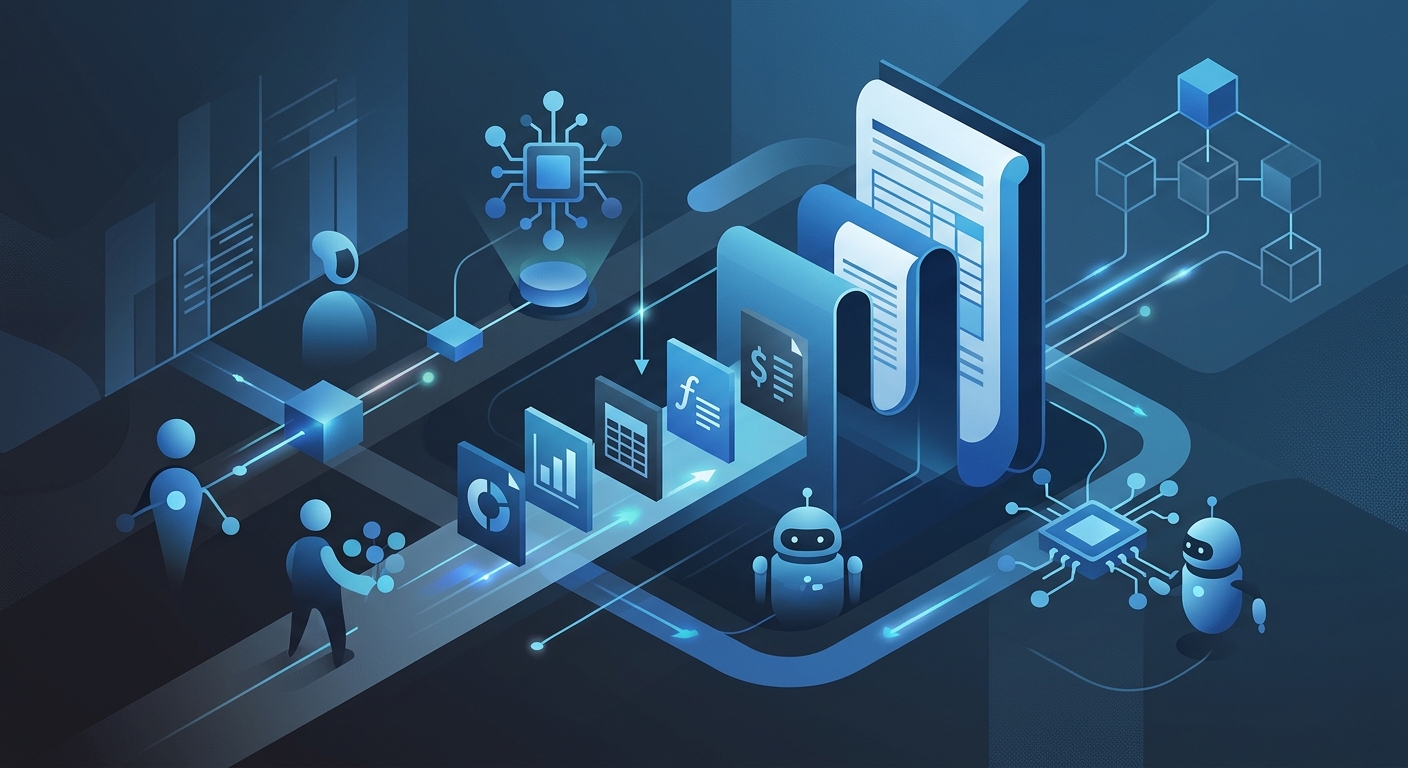
Securities and Exchange Commission (SEC) disclosure has evolved from a periodic administrative exercise into a continuous, high-stakes operational function. Yet most enterprises still treat reporting as a reactive cost center, relying on fragmented manual processes and legacy software incapable of scaling with regulatory complexity. At Meo, we reframe compliance as a measurable, performance-driven capability. By deploying autonomous AI agents as an accountable operational layer, enterprises replace unpredictable labor overhead with verified regulatory outcomes. This guide details the transition from manual bottlenecks to an outcome-driven compliance model.
The SEC Reporting Bottleneck: Why Manual Workflows Fail
Compliance teams face unsustainable scaling pressures as disclosure requirements multiply and reporting cycles compress. Manual data aggregation across disparate ERP systems, spreadsheets, and disclosure platforms introduces costly inaccuracies that directly trigger SEC comment letters and delayed filings SEC Division of Corporation Finance. These errors rarely stem from technical failures; they result from inconsistent reconciliation, misaligned narratives, and human fatigue during peak periods.
The financial impact compounds quickly. Enterprises routinely allocate thousands of billable hours to repetitive drafting, footnote mapping, and cross-functional reviews, driving labor costs upward while yielding diminishing returns. Legacy compliance software relies on rigid, rules-based logic. It formats data but cannot interpret regulatory nuance, trapping finance and legal teams in reactive cycles. Consequently, teams exhaust capacity maintaining baseline compliance instead of focusing on strategic risk mitigation or capital allocation insights.
Defining AI Agents for Automated Compliance
AI regulatory compliance agents are autonomous operational units engineered to execute end-to-end reporting with minimal human intervention. Unlike static software that digitizes templates, agents ingest real-time regulatory updates, apply contextual reasoning, and self-correct outputs prior to finalization. Industry analysis confirms that autonomous systems interpret complex frameworks, continuously monitor internal controls, and execute reporting workflows while substantially reducing operational risk Digiqt AI Compliance Guide.
The core architectural advantage is deterministic execution. Agents operate within strict guardrails mapped directly to SEC requirements, GAAP standards, and internal governance protocols. Every decision path, data transformation, and narrative generation step is recorded in immutable audit trails. This transforms compliance from a discretionary, labor-intensive service into a defensible, auditable function with traceable, verifiable outputs aligned to regulatory expectations.
Core SEC Reporting Capabilities of AI Agents
The operational core of automated compliance is precise, end-to-end filing execution. AI agents draft 10-K, 10-Q, and 8-K disclosures by ingesting and reconciling real-time financial data from general ledgers, automatically flagging variances that exceed materiality thresholds. Advanced natural language generation aligns Management’s Discussion and Analysis (MD&A) narratives with current accounting standards, while machine learning models execute precision XBRL tagging and schema validation against EDGAR requirements.
Industry benchmarks confirm that AI shifts teams from manual data entry to autonomous reconciliation and validation workflows ChatFin Audit Automation. Agents cross-reference historical filings, peer disclosures, and recent SEC comment letters to preemptively resolve regulatory friction before submission.
Beyond periodic filings, agents continuously monitor regulatory databases, FASB updates, and industry guidance. When rules change, they dynamically adjust reporting templates, control mappings, and validation checkpoints without manual reconfiguration. This ensures enterprises remain perpetually audit-ready rather than scrambling before deadlines. The result is a standardized reporting pipeline that compresses cycle times and elevates submission accuracy to institutional standards.
Enterprise Deployment: From Pilot to Production
Successful integration requires secure, non-disruptive connectivity with existing ERP, general ledger, and disclosure management ecosystems. Our Data Integration & Setup methodology prioritizes API-driven pipelines that synchronize financial records in real time while preserving legacy architecture. Agents are deployed in isolated, compliance-grade sandboxes where historical filing data trains, validates, and stress-tests behavior prior to production exposure.
Security and access governance are foundational. Deployments mandate role-based access controls, end-to-end encryption, and strict data residency protocols aligned with enterprise security standards. Cross-functional alignment across Legal, Finance, and IT is mandatory. A formal RACI matrix establishes clear operating boundaries, defining autonomous tasks, approval routing, and exception handling protocols. By embedding agents within existing governance frameworks rather than deploying them as isolated tools, enterprises maintain operational continuity while scaling reporting capacity across business units and fiscal periods.
The Accountability Framework: Measuring Outcomes, Not Effort
The traditional compliance model bills for hours worked, incentivizing complexity over efficiency. AI-driven reporting inverts this paradigm by shifting spend from billable time to outcome-based KPIs. Performance is measured strictly by filing accuracy, cycle time reduction, regulatory acceptance rates, and comment letter avoidance. Transparent operational dashboards track execution against predefined SLAs. Our Pay-for-Performance Model ensures capital deployment occurs only when verified results are delivered.
This framework eliminates vendor risk and aligns AI adoption directly with compliance ROI. When agents consistently achieve error-free submissions and reduce cycle times by 40–60%, organizations shift from budgeting for overhead to funding verified outcomes. Finance leaders gain predictable cost structures; compliance teams reclaim capacity for strategic analysis, control optimization, and investor relations. By decoupling cost from effort and tying it to verified regulatory acceptance, enterprises establish a self-correcting model that penalizes underperformance and rewards precision.
Risk Mitigation & Human-in-the-Loop Governance
Autonomy does not eliminate accountability; it refines it. Human oversight is reserved exclusively for high-judgment approvals, materiality assessments, and complex narratives, freeing legal and finance leaders from repetitive validation. Immutable logging and cryptographic version control satisfy SEC audit requirements, providing an unalterable record of every agent action and data transformation.
Security, Compliance & Governance protocols enforce fail-safe escalation mechanisms. If agents detect anomalies, data gaps, or confidence scores below predefined thresholds, workflows pause immediately and route exceptions to designated reviewers. This hybrid architecture guarantees enterprise-grade risk mitigation while maximizing automated throughput and preserving regulatory defensibility.
Next Steps: Scaling an Agent-Powered Compliance Workforce
Transitioning to an agent-driven reporting function begins with a structured readiness assessment that maps current disclosure workflows to automation potential. Organizations must establish phased rollout targets, measurable milestones, and integrated performance tracking. Partnering with outcome-priced providers ensures continuous monitoring, iterative optimization, and sustained regulatory alignment.
Conclusion
SEC reporting must operate as a precision instrument, not a resource drain. By deploying autonomous AI agents within a strict accountability framework, enterprises eliminate manual bottlenecks, improve regulatory accuracy, and transform compliance into a strategic advantage. Partner with Meo to deploy an accountable, performance-backed compliance workforce. Schedule a readiness assessment today to quantify efficiency gains and transition to verified outcomes.