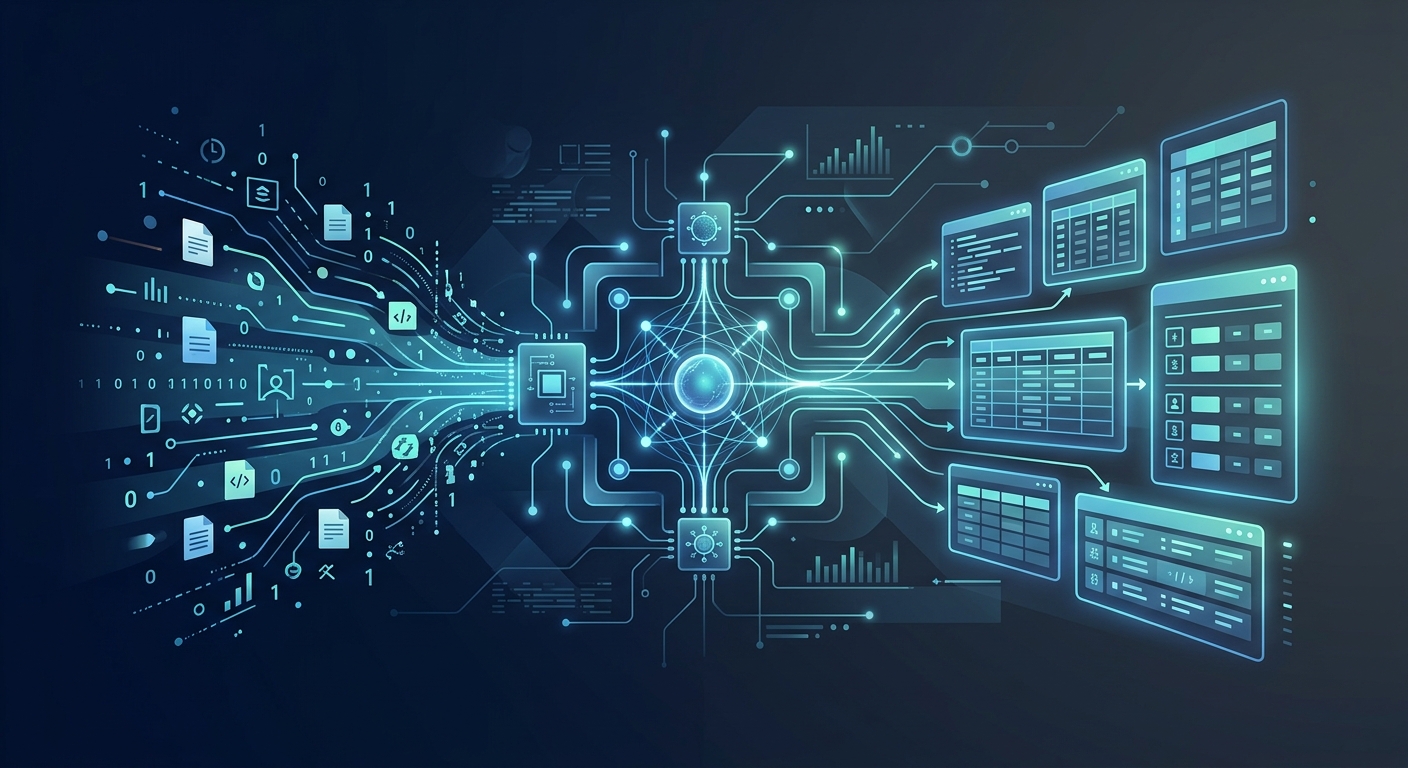
Manual data entry is no longer a tactical inefficiency—it is a measurable strategic liability. Organizations absorb disproportionate labor costs, error-driven rework, and compliance exposure simply to maintain foundational data integrity. While the market has shifted decisively toward automation, procurement strategies remain anchored to legacy licensing models that charge for capacity, not verified output. meo replaces this outdated approach with accountable AI agents operating as an outcome-driven workforce. Our pay-for-performance architecture eliminates upfront technology risk and ties investment directly to measurable back-office automation results. The following analysis details how modern AI agents replace rigid software, enforce enterprise-grade accountability, and deliver compounding data accuracy ROI without linear headcount growth.
The Operational Drag of Manual Data Input
The true cost of manual data entry extends far beyond hourly wages. Organizations routinely absorb hidden overhead from exception handling, compliance remediation, and the opportunity cost of misallocated talent. When analysts spend hours transcribing invoices or reconciling vendor records, strategic initiatives stall. Legacy rule-based automation and template-driven OCR fracture under modern data complexity, struggling with semi-structured layouts and inconsistent formatting. This rigidity demands continuous human intervention, negating promised efficiency gains. Industry benchmarks show AI-driven extraction can reduce manual workloads by approximately 70% Datagrid, yet enterprises reliant on legacy pipelines still face compounding rework rates. The strategic misalignment is clear: high-value teams remain trapped in low-value administrative cycles, eroding margins and delaying decisions. Modernizing this function requires shifting from static software to adaptive, goal-oriented architectures.
How AI Data Processing Evolves Beyond Basic Automation
Next-generation AI processing relies on context-aware extraction and semantic reasoning, not fixed coordinate mapping. Legacy OCR pipelines require manual rule updates whenever a vendor alters a template or a regulator modifies a form. AI agents, by contrast, interpret document structure, map field relationships, and validate data against historical patterns and business logic. Advanced architectures can automate complex extraction and routing without infrastructure overhauls Hyland. By integrating natively with ERP, CRM, and legacy databases via secure APIs, these systems preserve existing technology investments while eliminating data silos. Crucially, modern agents run continuous self-correction loops. Every processed record reinforces accuracy, systematically improving extraction precision and throughput velocity. Today’s systems routinely parse tables, classify relationships, and map fields across Excel, PDF, and Word documents with minimal configuration Kudra. This adaptive architecture transforms back-office processing from a maintenance-heavy cost center into a compounding operational asset.
From Software Tool to Accountable AI Workforce
meo deploys AI agents as measurable, goal-oriented digital employees, governed by explicit service-level agreements. Each agent operates under strict SLAs defining processing velocity, validation standards, and exception-handling protocols. Enterprise-grade audit trails and immutable logging guarantee complete data lineage, meeting compliance requirements across finance, procurement, and regulatory functions. Secure human-in-the-loop oversight resolves complex edge cases without disrupting core workflows, maintaining accuracy at the contracted SLA level while preserving operational continuity. Real-time dashboards provide executive visibility into processing metrics, tracking error rates, cycle times, and exact cost-per-record figures. By automatically structuring and routing extracted data, these agents ensure database consistency and keep critical records audit-ready for downstream analytics Zapier. This shift from passive software to an active, accountable workforce targets verifiable business outcomes, not speculative efficiency projections.
The Pay-for-Performance Deployment Model
Traditional procurement traps organizations in speculative licensing costs, charging for capacity regardless of utilization, output quality, or business impact. meo’s pay-for-performance model inverts this dynamic by aligning vendor incentives with verified results. Organizations pay only when agents successfully process, validate, and route data against predefined accuracy benchmarks. Transparent pricing ties directly to processed volume, validation thresholds, and core KPIs, converting AI processing from a capital expenditure into a variable, outcome-driven lever. This approach eliminates financial risk, accelerates data accuracy ROI, and mandates continuous optimization from deployment. As enterprises scale automation across departments, capacity expands without linear headcount growth or compounding infrastructure costs. Dynamic agent allocation absorbs demand spikes, while baseline overhead remains controlled. The result is a predictable operating model that transforms administrative drag into a measurable competitive advantage.
Executive Roadmap for Implementation and Scale
Deploying an accountable AI workforce requires disciplined execution, not experimental rollouts. Successful implementation follows a phased approach: comprehensive mapping of existing data flows, controlled pilots against live document streams, and enterprise-wide deployment governed by strict performance milestones. Operations, finance, and IT leadership must align through standardized change management protocols covering workflow redesign, exception routing, integration checkpoints, and role reallocation. Governance frameworks must define data handling policies, security boundaries, and escalation matrices prior to launch. Immediate next steps include scoping quantifiable success metrics, establishing audit compliance standards, and structuring outcome-based contracts that guarantee processing SLAs. Treating automated entry as a strategic workforce initiative—rather than a tactical IT upgrade—enables enterprises to systematically eliminate manual bottlenecks, secure predictable processing standards, and redirect talent toward revenue-generating initiatives.
Conclusion
The era of funding unproven software capacity is over. Deploying an accountable AI workforce through a performance-aligned model transforms back-office processing from a fixed cost center into a scalable, results-driven function. meo’s architecture delivers measurable data accuracy ROI, eliminates upfront technology risk, and scales capacity without compounding operational overhead. Contact our team to define success metrics, establish governance frameworks, and deploy pay-for-performance AI agents engineered for verified business outcomes.