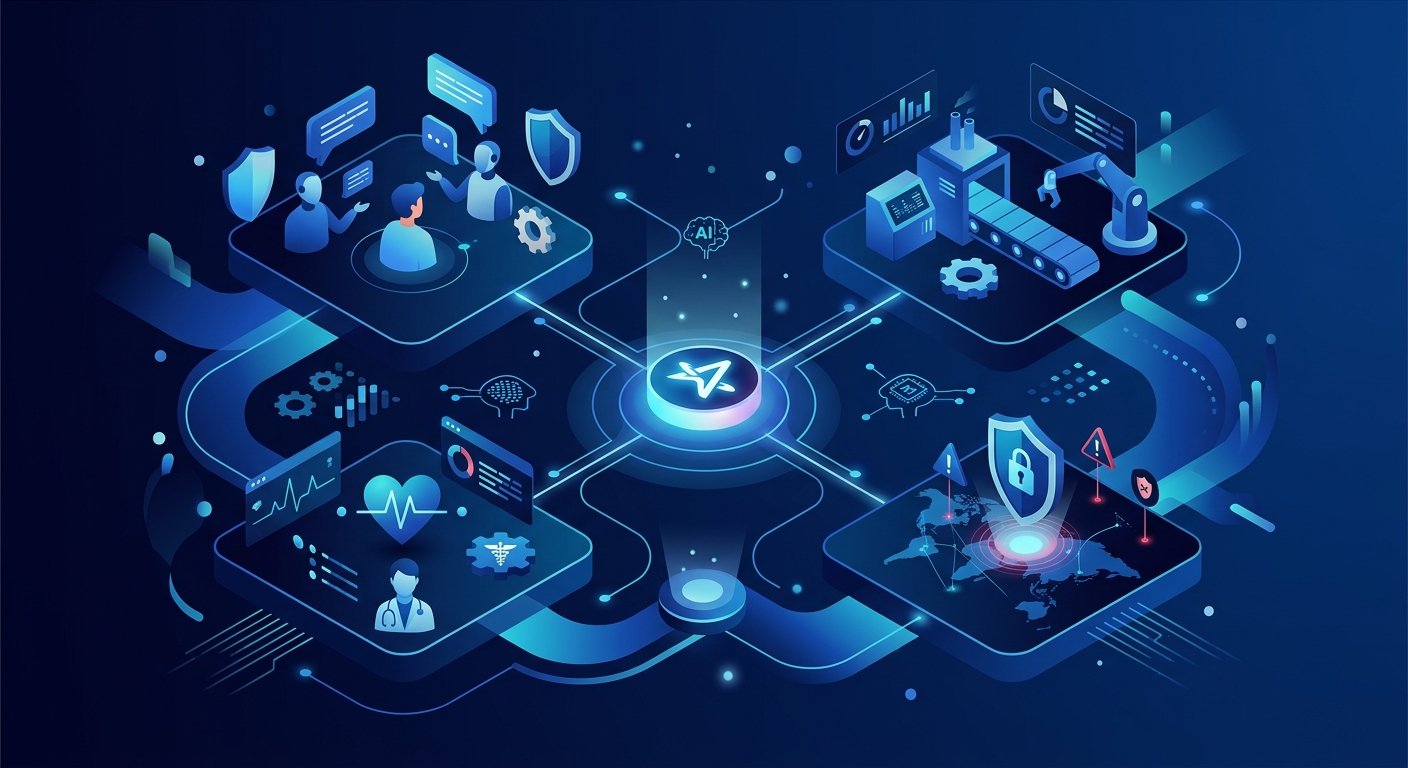
Agentic AI is an advanced class of artificial intelligence characterized by its ability to act autonomously to achieve complex, multi-step goals without continuous human prompting. Unlike traditional chatbots that require a specific prompt for every response, an autonomous agent can plan its own workflow, use external tools, and self-correct when it encounters errors. This shift from passive assistance to active execution is fundamentally redefining how organizations approach AI Agents For Business Automation.
Key Takeaways
- Autonomy vs. Assistance: Agentic AI differs from generative AI in its ability to break down complex goals into sub-tasks and execute them autonomously across various software environments.
- Reasoning Loops: These systems use "reflection" and "planning" capabilities to review their own work, leading to higher accuracy in complex tasks like coding and logistics.
- Quantifiable Impact: Harvard Business Review reports an 80% reduction in manual coding tasks when using agentic coding assistants for refactoring and testing.
- Human-in-the-Loop: Critical enterprise deployments require HITL guardrails to prevent irreversible financial or legal actions by autonomous systems.
What is Agentic AI?
Agentic AI is a system powered by Large Language Models (LLMs) that has the agency to pursue objectives independently. While standard generative AI acts as a sophisticated text generator, agentic AI functions as a digital worker. It uses reasoning frameworks—often referred to as "Chain of Thought"—to analyze a high-level goal, determine the necessary steps to reach it, and then execute those steps using integrated tools like APIs, web browsers, or database queries.
According to the NIST AI Report 2024, the defining characteristic of these systems is their "goal-oriented" nature. Instead of simply predicting the next word in a sentence, an agent predicts the next action required to solve a problem. This makes them well-suited for environments where the path to a solution is not linear and requires real-time adaptation.
How Does Agentic AI Work?
To understand how agentic AI works, consider the cycle of perception, reasoning, and action. A standard LLM receives an input and provides an output. An agentic workflow, by contrast, involves a continuous loop. When a user provides a complex objective—such as "Reconcile all invoice discrepancies for Q3"—the agent does not attempt to answer immediately. Instead, it enters a planning phase.
- Decomposition: The agent breaks the objective into smaller, manageable tasks (e.g., fetch Q3 invoices, compare against bank statements, identify mismatches).
- Tool Selection: The agent identifies which external software tools it needs to access, such as an ERP system or a PDF parser.
- Execution and Observation: The agent performs the task and observes the result. If a tool returns an error, the agent uses its reasoning capability to troubleshoot and try a different approach.
- Reflection: Before presenting the final result, the agent reviews its own work for logical consistency and accuracy.
This iterative process is what allows agentic systems to handle AI Functionality that would be impossible for a simple prompt-response model.
How is Agentic AI Different from Generative AI?
The distinction between generative AI and agentic AI is primarily one of scope and agency. Generative AI is a subset of AI focused on creating content—text, images, or code—based on training data. Agentic AI uses generative AI as its "brain" but adds layers of autonomy and tool use.
| Feature | Generative AI (Standard) | Agentic AI |
|---|---|---|
| Core Function | Content generation and summarization | Goal-oriented task execution |
| User Input | Frequent, sequential prompting required | Single high-level goal provided |
| Workflow | Linear (Input -> Output) | Iterative (Plan -> Act -> Reflect) |
| Tool Access | Usually limited to text processing | Full API and software integration |
| Autonomy | Low (passive assistant) | High (autonomous operator) |
For a deeper dive into these differences, see our guide on What is Generative AI vs Agentic AI?.
Benefits of Agentic AI for the Enterprise
Implementing agentic workflows offers significant scalability and efficiency gains that go beyond simple automation. Because these agents can work 24/7 and manage their own error correction, they substantially reduce the human-in-the-loop requirements for routine but complex processes.
Key Insight: Agentic AI marks a shift from tools that help people work better to agents that work on their behalf (HBR: How Agentic AI Is Changing the Workplace).
Key benefits include:
- Increased Resolution Rates: In customer support, agentic systems have shown a 40% improvement in resolution rates for tier-1 technical roles because they can navigate the backend to fix user problems directly, rather than simply explaining how to fix them.
- Cost Efficiency at Scale: While the initial cost per task can be higher—multi-agent loops can consume 4x more tokens than single queries—the reduction in human labor hours often produces a strong net ROI.
- Complex Problem Solving: Agents excel at tasks that involve unstructured data or ambiguous logic, such as AI Agents For Invoice Exception Handling.
Key Features of Agentic AI Systems
To be considered truly "agentic," a system must possess several core architectural features:
- Stateful Memory: The agent must remember what it has already tried and what it has learned during task execution. This prevents the agent from getting stuck in infinite loops.
- Multi-Agent Collaboration: In advanced setups, multiple specialized agents work together. One agent might act as a "Coder," while another acts as a "Reviewer," ensuring high-quality outputs through peer-review loops.
- Self-Correction (Reflection): This is the ability of the agent to examine its own output, identify a mistake, and re-run the process without human intervention.
- Dynamic Planning: The ability to adjust the plan mid-execution if the environment changes—for example, if a server goes down or new data becomes available.
Real-World Examples of Agentic AI
1. Autonomous Coding Agents
Software engineering is perhaps the most mature field for agentic AI. Agents like Devin or OpenDevin can take a GitHub issue, explore the codebase, write a fix, run the tests, and submit a pull request. This has contributed to an 80% reduction in manual coding tasks for refactoring projects Harvard Business Review. For more on this topic, explore Will AI Replace Programmers?.
2. Supply Chain Orchestrators
In logistics, agentic systems can autonomously re-route shipments based on real-time weather or geopolitical disruptions. Rather than alerting a human to a delay, the agent queries alternative carriers, compares costs, and re-books the shipment within pre-approved budget parameters.
3. Autonomous HR Onboarding
An enterprise HR agent can manage the entire onboarding lifecycle. It verifies documents, triggers background checks, provisions equipment in IT systems, and schedules orientation meetings—coordinating across five or six different software platforms without human oversight.
4. Sales and Revenue Operations
Enterprise AI SDR Deployment involves agents that go beyond sending emails: they research prospects, update CRM data, and negotiate meeting times across calendars autonomously.
Use Cases for Agentic AI in Finance and Compliance
Finance and legal sectors are using agents for high-stakes monitoring. For example, Autonomous Regulatory Change Monitoring AI can scan thousands of pages of new legislation, determine which specific company policies are affected, and draft the necessary updates for human legal counsel to review.
Other use cases include:
- Fraud Detection: Agents that do not just flag transactions but actively investigate them by cross-referencing social data and historical patterns.
- Tax Preparation: Agents that can navigate complex tax codes and reconcile them with thousands of corporate transactions.
Considerations and Challenges of Agentic AI
Despite the potential, transitioning to an agentic system requires addressing significant technical and ethical hurdles. Moving from a standard LLM to an autonomous system requires a specific technical stack, including an orchestrator (like LangGraph or CrewAI) to manage stateful planning and a memory layer (like Mem0) to track entity relationships over time.
Key Insight: Running a multi-agent loop for a complex task can cost approximately 193,600 tokens—roughly four times the cost of a single-prompt approach—due to the high volume of iterative LLM calls.
Organizations must also implement Human-in-the-Loop (HITL) guardrails. This means placing trained humans at critical decision points to approve or reject actions before they take effect in production, particularly for financial transfers or legal filings. Without these controls, the risk of "agentic drift" or autonomous errors could create significant liability.
How Agentic AI Works within Slack and Enterprise Tools
Many enterprises are deploying agents directly into their communication platforms. In Slack, an agentic AI does not just answer questions—it acts as a project manager. It can identify action items in a thread, create tickets in Jira, update the project timeline in Monday.com, and post a summary back into the Slack channel. This integration allows the agent to function within the existing Enterprise AI Agent Orchestration framework of the company.
Frequently Asked Questions
What is the main difference between an AI agent and a chatbot?
A chatbot is reactive and follows a linear conversation. An AI agent is proactive and goal-oriented, capable of using tools and making independent decisions to complete a multi-step task.
Do I need to know how to code to use agentic AI?
While low-code platforms are emerging, enterprise-grade agentic systems typically require a technical stack involving orchestrators like LangGraph and a solid understanding of API integrations.
How do you prevent an AI agent from making a serious mistake?
By using HITL (Human-in-the-Loop) guardrails and "constrained agency," where the agent is only permitted to execute certain actions—such as spending money—after human approval.
Is agentic AI more expensive than ChatGPT?
Yes, in terms of compute and token usage. Because agents reason in loops and reflect on their work, they often use 4x to 10x more tokens than a single prompt-response query.
Can agents work together?
Yes. Multi-agent systems (MAS) involve different agents with specialized roles—such as a researcher, a writer, and an editor—collaborating to produce a higher-quality result than a single agent could achieve alone.