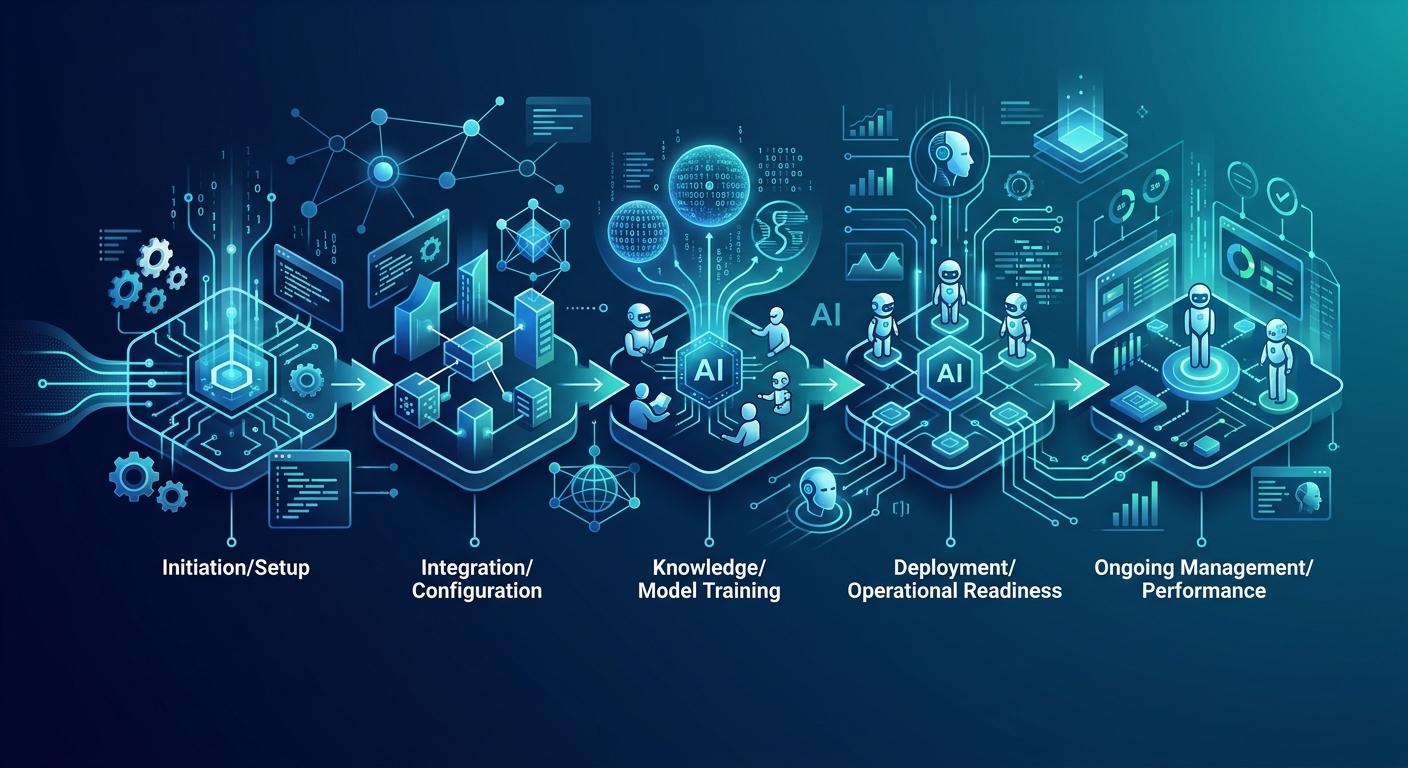
Traditional enterprises no longer face an AI adoption problem; they face an AI orchestration challenge. For years, organizations have confined autonomous intelligence to isolated proof-of-concept pilots, generating incremental efficiency but minimal structural impact. The next phase of digital transformation requires a fundamental shift: treating AI agents not as software add-ons, but as accountable, scalable members of the operational workforce. Successful onboarding demands embedding these digital workers directly into core value streams, governed by strict performance metrics and aligned with a clear mandate to replace redundant labor overhead with verifiable business outcomes. This guide outlines the execution framework required to transition from experimental fatigue to enterprise-grade scale.
From Pilot Fatigue to Agentic Scale: The Case for an AI-First Culture
Experimental AI pilots are obsolete as primary deployment strategies. Organizations that continue to sandbox generative models in disconnected environments will stall in what industry analysts term "pilot purgatory." An AI-first operating model embeds autonomous agents directly into mission-critical workflows. These agents execute tasks, trigger downstream processes, and own specific operational outcomes without requiring constant human prompting. This transformation redefines legacy structures by treating AI as strategic capital rather than a tactical IT upgrade.
Executing this shift requires clear executive sponsorship and cross-functional accountability frameworks before provisioning begins. According to Harvard Business Review, the primary barrier to scaling AI is not technological capability, but the failure to redesign work processes and governance models to accommodate autonomous execution Create an Onboarding Plan for AI Agents. Leadership must mandate outcome ownership, assign operational stewardship, and align departmental KPIs directly with agent performance. Without this foundational cultural and operational realignment, agentic AI remains a novelty rather than a workforce multiplier.
Mapping Agent Roles to Business Outcomes & Labor Optimization
Deploying an agentic workforce requires precise role mapping. Start by auditing existing workflows to identify high-friction, rule-dense processes that drain human capital—such as invoice reconciliation, compliance documentation, or multi-tier customer triage. These bottlenecks are optimal candidates for autonomous agent deployment.
Successful implementation requires designing explicit KPIs tied directly to overhead reduction, throughput acceleration, and error elimination. Each agent must map to a specific financial or operational metric, guaranteeing a verifiable reduction in cost-per-transaction or an increase in cycle velocity 5 Essential Agentic AI Tools Revolutionizing Your Workflow in 2026. Human oversight should function strictly as an exception-handling layer, not an operational bottleneck. By establishing clear delegation boundaries, enterprises prevent disruption while maximizing autonomous throughput. This structured approach transforms AI deployment into a predictable engine for labor optimization: AI manages volume and complexity, while human talent focuses on exception management, strategy, and high-value engagement.
The Enterprise Onboarding Protocol: Integration, Validation & Handoff
Enterprise-grade AI onboarding requires a rigorous, phased protocol built on security, validation, and operational handoff. Ad hoc integrations introduce unacceptable risk.
The initial phase mandates isolated sandbox environments where agents interact with live data structures without compromising production integrity. These controlled environments enable safe testing, compliance validation, and stringent security audits, ensuring zero-trust principles govern every data exchange Best Practices for AI Agent Implementations: Enterprise Guide 2026. Following validation, deployment must adhere to strict phased rollout milestones with hard performance gates. Agents only graduate to broader operational scope after demonstrating consistent accuracy, latency compliance, and adherence to Security, Compliance & Governance standards at micro-scale.
Organizations must also document comprehensive Standard Operating Procedures (SOPs) covering agent-human escalation paths, exception handling protocols, and immutable audit trails. These SOPs ensure operational continuity and regulatory readiness. Robust Agent Monitoring & Quality Assurance mechanisms track decision matrices in real time, enabling engineering teams to intercept drift before it impacts downstream processes. This disciplined framework eliminates deployment risk and guarantees that every agent enters production as a validated, audit-ready operational asset.
Performance Tracking & Outcome-Based Investment Models
Traditional software procurement models are misaligned with autonomous workforce deployment. Flat subscription licensing forces enterprises to pay for capacity, not results, effectively subsidizing underutilization. To drive measurable ROI, organizations must transition to pay-for-performance AI deployment structures that tie financial investment directly to verified operational outcomes.
Real-time telemetry dashboards serve as the operational command center, tracking critical metrics such as agent accuracy, resolution velocity, first-touch success rates, and direct labor cost displacement. By quantifying these outputs financially, finance and operations teams can validate ROI on a per-agent basis. This transparency enables stringent Service Level Agreements (SLAs) and performance guarantees that align vendor accountability with enterprise financial targets. When agents consistently meet or exceed predefined thresholds for cost avoidance and revenue acceleration, investment scales automatically. Underperforming deployments are isolated, recalibrated, or decommissioned without sunk-cost penalties. This outcome-driven commercial model removes adoption friction and ensures the AI workforce operates with the fiscal discipline expected of high-performing teams. Explore how enterprises are restructuring vendor contracts around verified outcomes through our Pay-for-Performance Model.
Scaling the Agentic Workforce: Continuous Optimization & Cultural Adoption
Initial deployment is the baseline, not the end state. True enterprise scale requires closed-loop feedback mechanisms that continuously refine agent decision matrices, contextual awareness, and autonomy levels using live operational data. As agents process more transactions, reinforcement learning and human-in-the-loop feedback systematically reduce error rates and expand functional capabilities.
Simultaneously, organizations must train leadership and frontline operators to manage, direct, and collaborate with AI agents as digital colleagues. This requires a fundamental management paradigm shift: moving from task supervision to outcome orchestration and strategic delegation The agentic reality check: Preparing for a silicon-based workforce. Executives must proactively plan long-term workforce reallocation, strategically mapping displaced labor toward high-value growth initiatives such as product innovation, market expansion, and advanced analytics. By reinvesting operational savings into revenue-generating functions, enterprises transform AI from a cost-reduction tool into a compound growth engine. Validate your organization’s readiness for this transition using our Agentic Readiness Assessment and track proven deployment outcomes across ROI & Performance Metrics.
Conclusion
Transitioning to an AI-driven enterprise is not a technology upgrade; it is a structural workforce transformation. Organizations that treat AI agent deployment with the same rigor as executive hiring, operational governance, and performance-based compensation will systematically dismantle legacy inefficiencies and capture scalable, verifiable ROI. By embedding agents into core workflows, enforcing strict accountability metrics, and adopting outcome-based commercial structures, enterprises can exit pilot purgatory and build resilient, results-driven operations. The future belongs to organizations that deploy AI not as a tool, but as an accountable workforce.