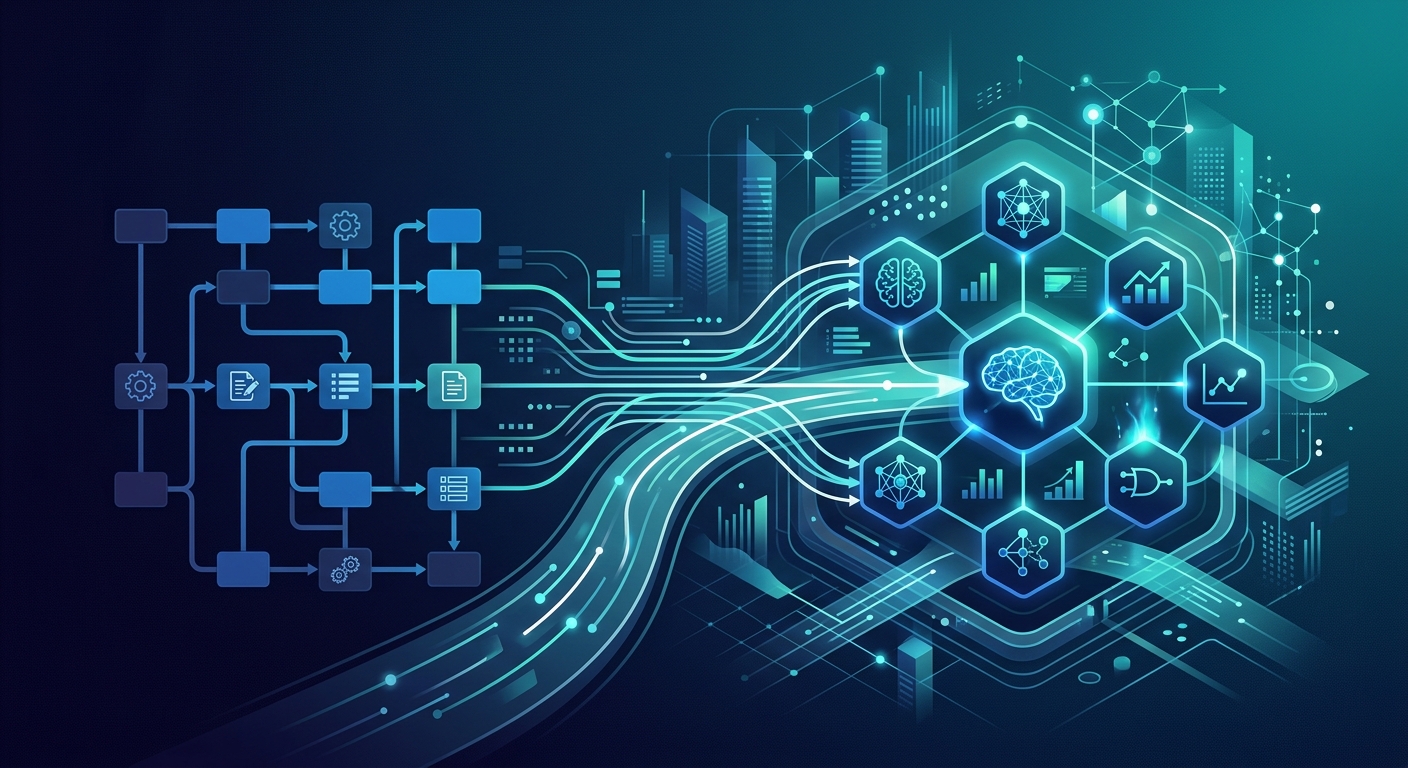
The enterprise automation landscape is at an inflection point. What began as a tactical effort to digitize repetitive keystrokes with Robotic Process Automation (RPA) is now a strategic imperative for cognitive, outcome-driven operations. For executives, the decision to adopt AI agents is no longer a software upgrade—it is a workforce transformation. At Meo, we enable enterprises to replace brittle, labor-intensive script maintenance with a scalable, accountable AI workforce. This guide outlines how to migrate from legacy automation to agentic systems, de-risk deployment, and align technology spend directly with verified business outcomes through a pay-for-performance model.
The RPA Ceiling: Why Rule-Based Automation Fails to Scale
Legacy RPA operates on a rigid premise: digital workers that execute predefined rules across stable interfaces. While effective for high-volume, predictable tasks, this architecture hits a hard ceiling. Maintenance overhead compounds rapidly as every system update, UI change, or exception breaks rigid scripts, trapping IT teams in continuous debugging cycles. Rule-based systems also lack the cognitive flexibility to process unstructured data—emails, contracts, or voice transcripts—or adapt to shifting business conditions without costly re-engineering. The result is a hidden labor cost: highly paid engineers spend more time patching technical debt than driving strategic initiatives. Scaling legacy RPA requires linear increases in oversight, not exponential gains in output. Organizations that ignore this ceiling will see their automation programs stall under technical debt, draining budgets meant for growth.
AI Agents vs. RPA: The Architectural & Operational Shift
The transition from rule-based automation to agentic AI is fundamental. Where RPA replays static logic, AI agents apply cognitive reasoning, contextual awareness, and adaptive decision-making to navigate ambiguity and execute complex workflows. Modern agents leverage large language models (LLMs) and tool-use frameworks to self-heal execution paths, dynamically route exceptions, and orchestrate actions across enterprise systems with minimal human intervention. This shifts leadership focus from tracking task completion to enforcing outcome ownership. Instead of programming sequential clicks, organizations deploy autonomous workforce units that own end-to-end functions—from supplier onboarding to dispute resolution—while continuously optimizing their own processes. The competitive advantage is not speed; it is adaptability, judgment, and measurable business impact.
Enterprise Migration Blueprint: Phased & De-Risked
Migrating from legacy automation requires a structured methodology—not a rip-and-replace approach. Phase one begins with rigorous process triage, dependency mapping, and prioritizing high-friction workflows where unstructured data and frequent exceptions create the most manual drag. Deploy AI agents in shadow mode alongside existing RPA, running parallel executions to benchmark accuracy, latency, and exception resolution without disrupting live operations. This validation phase surfaces edge cases, establishes baseline metrics, and builds organizational trust before any cutover. As confidence grows, transition to hybrid orchestration: let traditional RPA handle high-volume basics while AI agents manage complex, judgment-intensive tasks. Full migration requires modernizing data pipelines, shifting from screen-scraping to structured, event-driven integrations that provide agents with clean, real-time context. This phased approach ensures continuity, minimizes risk, and allows IT and business leaders to co-develop governance standards while scaling intelligently.
Governance, Security & Accountability Framework
Autonomy without accountability creates enterprise risk. Deploying AI agents at scale requires an immutable audit trail that logs every decision, data access, and action. Implement explainability layers and compliance guardrails to align with regulatory standards and internal risk thresholds. Enforce strict role-based access controls (RBAC) and establish human-in-the-loop escalation protocols for high-stakes decisions or confidence scores below predefined benchmarks. Enterprise-grade platforms constrain agents through tool permissions, structured output validation, and deterministic checks before committing changes. Without rigorous observability and automated evaluation, scale introduces unpredictable exposure. Meo’s framework embeds vendor accountability directly into deployment contracts, replacing opaque licensing with transparent, performance-based agreements. This shifts governance from reactive monitoring to proactive assurance, ensuring every agent operates within secure, auditable, and business-aligned boundaries.
The Pay-for-Performance Model: Aligning Cost With Outcomes
Traditional automation locks enterprises into CAPEX-heavy licensing, paying for seats, infrastructure, and maintenance regardless of output. The pay-for-performance model reverses this dynamic, shifting to variable, outcome-driven OPEX. Instead of tracking bot utilization or script executions, organizations establish SLA-backed metrics tied directly to ROI: invoice processing accuracy, case resolution time, compliance adherence, or revenue leakage prevention. Funding scales only when verified outcomes are delivered. This risk-reversal model eliminates upfront financial exposure and aligns vendor incentives with client success. When AI agents operate as an accountable workforce rather than a software purchase, enterprises pay exclusively for measurable results. Meo structures engagements so technology investment scales proportionally with delivered value, transforming automation from a fixed cost center into a self-funding growth engine.
Executive Implementation Checklist
Successful migration hinges on disciplined execution and cross-functional alignment.
- Conduct a readiness assessment evaluating data maturity, API accessibility, and organizational change capacity.
- Map KPIs to clear success thresholds, establishing baseline metrics for accuracy, throughput, and exception rates.
- Execute a 90-day rollout: 30 days for process selection and shadow-mode validation, 30 days for hybrid orchestration and governance calibration, and 30 days for full-scale deployment and ROI verification.
- Vet technology partners against a strict matrix: proven agentic architecture, transparent observability dashboards, and contractual willingness to tie compensation to verified outcomes.
- Deploy structured workforce transition protocols, reskilling RPA developers and operations staff into AI supervisors and outcome managers.
The shift from legacy RPA to AI agents is not a technical migration—it is an operational and financial transformation. By replacing brittle scripts with cognitive, outcome-owning agents, enterprises eliminate hidden maintenance debt and unlock scalable, accountable automation. At Meo, we structure deployments around a strict pay-for-performance model, ensuring you only fund agents that deliver verified business results. Ready to de-risk your migration and convert automation overhead into measurable ROI? Contact our enterprise team to schedule a readiness assessment and launch a risk-free pilot.