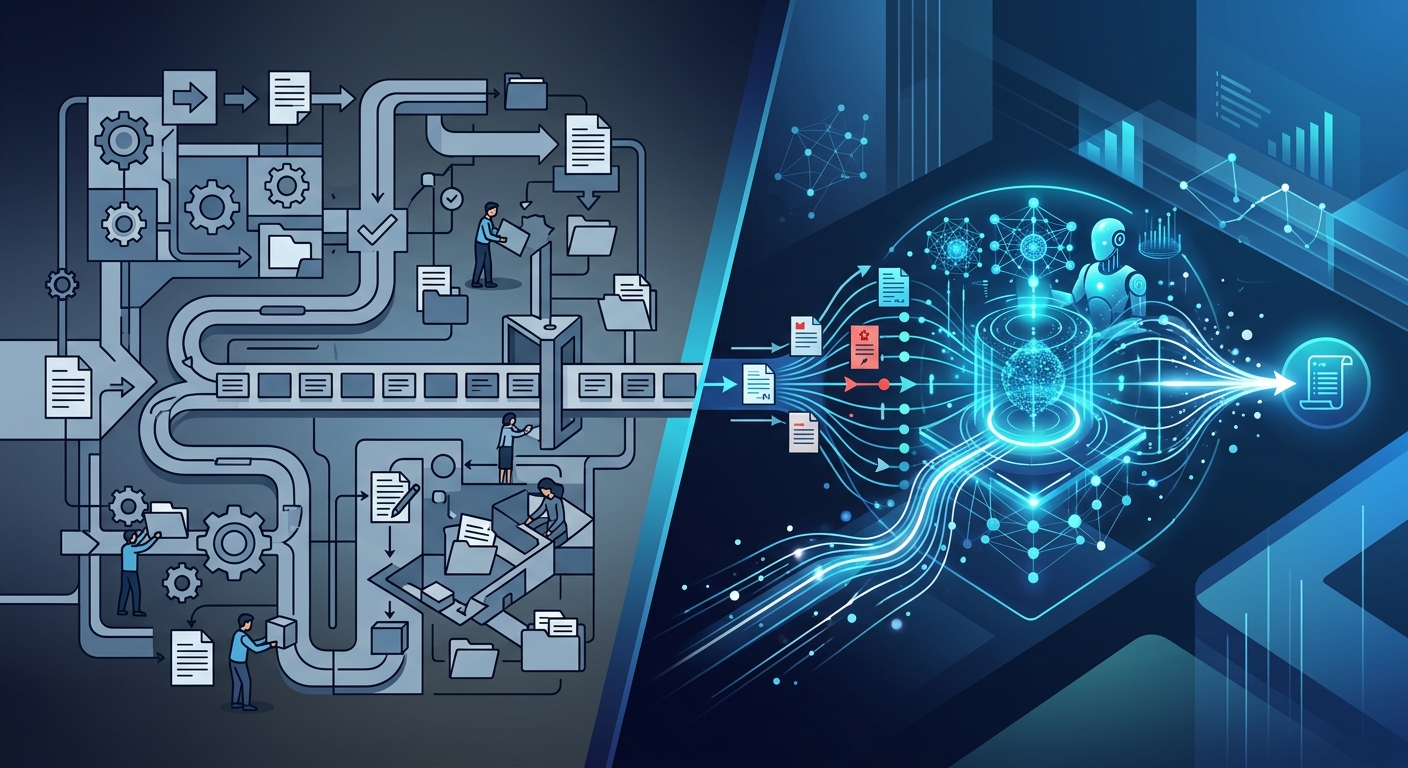
Modern accounts payable departments face a paradox: transaction volumes are accelerating, yet exception handling remains trapped in a cycle of manual intervention. As enterprises scale, the limitations of legacy workflow systems compound into measurable financial drag. The industry is rapidly shifting from maintaining brittle scripts to deploying autonomous, outcome-driven systems. Comparing AI agents and traditional automation is no longer optional for finance leaders—it is a strategic imperative. This analysis examines how agentic AI replaces rigid rule-based architectures with a scalable, accountable workforce that aligns directly with executive financial objectives.
The Hidden Cost of Rule-Based Invoice Workflows
Rule-based invoice workflows promise efficiency but deliver operational fragility. Static RPA and deterministic logic fracture when confronted with non-standard vendor layouts, mismatched purchase orders, or ambiguous tax codes. Rather than resolving exceptions, these systems merely flag them, routing discrepancies to human analysts for manual triage. This creates a hidden full-time equivalent (FTE) burden that scales linearly with transaction volume. Every new vendor template, policy change, or ERP schema update demands manual script reconfiguration, driving maintenance overhead that quietly erodes projected ROI.
Furthermore, deterministic routing lacks contextual reasoning. When an invoice deviates even marginally from a predefined template, the workflow halts. AP teams are forced into reactive firefighting: manually reconciling line items, chasing internal approvals, and deciphering unstructured notes. The operational toll is predictable—delayed month-end closes, strained vendor relationships, and a compliance posture dependent on human oversight rather than systematic control. When evaluating AI agents against traditional automation, rigid architectures prove structurally unsuited for modern procurement complexity. Organizations clinging to deterministic models are effectively subsidizing inefficiency with headcount, turning a tactical function into a strategic bottleneck.
How Agentic AI Handles Exceptions Autonomously
Agentic AI transforms exception handling from a reactive bottleneck into a proactive control function. Unlike brittle scripts that follow rigid pathways, intelligent agents apply contextual reasoning to parse unstructured invoices, cross-reference live ERP data, and resolve financial discrepancies without human prompting. When a mismatched PO or missing approval surfaces, the system does not stall. Instead, it triggers dynamic workflow orchestration: autonomously querying vendor portals via API or email, validating internal approval hierarchies against corporate governance frameworks, and applying compliant accounting treatments aligned with your specific chart of accounts.
This capability is sustained by self-correcting decision loops. Every resolution is evaluated against financial controls, validated by secondary verification layers, and used to refine future decision pathways. By embedding strict guardrails, tool permissions, and deterministic checks before committing ledger changes, these systems maintain ironclad auditability while eliminating manual handoffs. The result is an AP function that anticipates variances, negotiates missing documentation, and closes exceptions at machine speed. Where legacy tools require constant oversight, agentic systems operate as a continuously improving workforce, turning exception management into a measurable competitive advantage.
AI Agents vs. Traditional Automation: A Direct Comparison
The distinction between AI agents and traditional RPA lies not in processing speed, but in cognitive architecture, adaptability, and scalability. Traditional rule engines execute predefined paths with mathematical precision, but they demand constant reconfiguration when business logic, vendor formats, or regulatory requirements shift. Agentic systems adapt to novel invoice structures and policy changes through semantic understanding and continuous learning. Scaling traditional automation requires provisioning additional bot licenses, expanding infrastructure, and managing exponential maintenance queues. AI agents and traditional automation scale fundamentally differently: intelligent agents process increasingly complex exception types within the same compute footprint, absorbing variability without proportional cost increases.
As organizations navigate multi-departmental procurement, AI bridges the gap between rigid execution and strategic financial decision-making. Workflow automation follows a static map; intelligent agents navigate dynamic terrain. Agents evaluate contextual intent, negotiate missing data, and generate auditable rationales for every financial adjustment. Enterprises frequently misallocate resources by forcing RPA into high-variance scenarios. Optimal architecture leverages traditional automation for high-volume, predictable tasks while deploying agentic AI for complex, unpredictable workflows. Unlike deterministic tools that fail on edge cases, agentic systems triage exceptions, autonomously resolve standard discrepancies, escalate only what requires human judgment, and learn from both outcomes. This creates a transparent, accountable pipeline that replaces guesswork with auditable intelligence.
The Economics of Intelligent Agents vs. Workflow Automation
The financial architecture of traditional workflow automation is fundamentally misaligned with modern AP objectives. Legacy procurement software and RPA platforms charge per bot seat, platform uptime, and heavy upfront implementation fees, forcing organizations to pay for speculative capacity rather than delivered business outcomes. This seat-based pricing transforms automation into a fixed cost center, where ROI is consistently diluted by maintenance, licensing renewals, and incremental IT support. Agentic AI flips this economic model entirely.
By deploying a pay-for-performance framework, enterprise investment is strictly tied to measurable results: resolved exception counts, reduced processing cycle times, recovered early-payment discounts, and eliminated manual labor hours. This eliminates speculative software spend, ensuring every allocated dollar correlates directly to improved working capital and tighter financial controls. When traditional deterministic systems encounter novel exceptions, the cost is absorbed internally through extended analyst overtime and delayed financial reporting. With an accountable agentic workforce, financial risk shifts from the enterprise to the technology provider. Replacing brittle scripting with outcome-driven agents transforms accounts payable from an operational drain into a variable, ROI-positive capability. Finance leaders no longer fund automation on promise; they purchase verified financial outcomes.
Deploying a Scalable, Accountable Agentic Workforce
Deploying a scalable agentic workforce requires strategic integration, not disruptive system overhauls. A phased rollout alongside legacy ERP and existing AP infrastructure ensures zero operational disruption while establishing clear, measurable KPIs for exception resolution rates, accuracy thresholds, and cycle-time compression. Enterprise-grade observability, automated evaluation pipelines, and continuous monitoring provide real-time performance tracking, ensuring agents operate within strict financial and compliance guardrails.
Transparent audit trails and executive dashboards deliver complete visibility into agent efficacy, regulatory adherence, and cost recovery metrics, transforming opaque automation into a fully accountable operational asset. Crucially, the commercial structure must mirror the operational promise. A strict pay-for-results guarantee aligns vendor accountability directly with your business outcomes, removing implementation risk and accelerating positive ROI. This model positions intelligent agents as a low-risk, high-yield upgrade, enabling CFOs and operations leaders to replace fixed labor overhead with a dynamic, measurable digital workforce. The transition from patching brittle scripts to deploying an outcome-driven AI team is no longer experimental—it is the definitive standard for enterprise AP modernization.
Conclusion: From Automation Maintenance to Accountable Outcomes
Stop funding rigid systems that require constant maintenance and deliver diminishing returns. The future of accounts payable belongs to autonomous, accountable digital workers that pay for themselves through measurable efficiency gains and accelerated cash flow. At Meo, we deploy agentic AI as a scalable workforce, backed by outcome fees tied to agreed metrics. You only invest when agents deliver verified business results. Schedule a workflow assessment today to quantify your exception handling ROI and transition from legacy automation to accountable, outcome-driven intelligence.