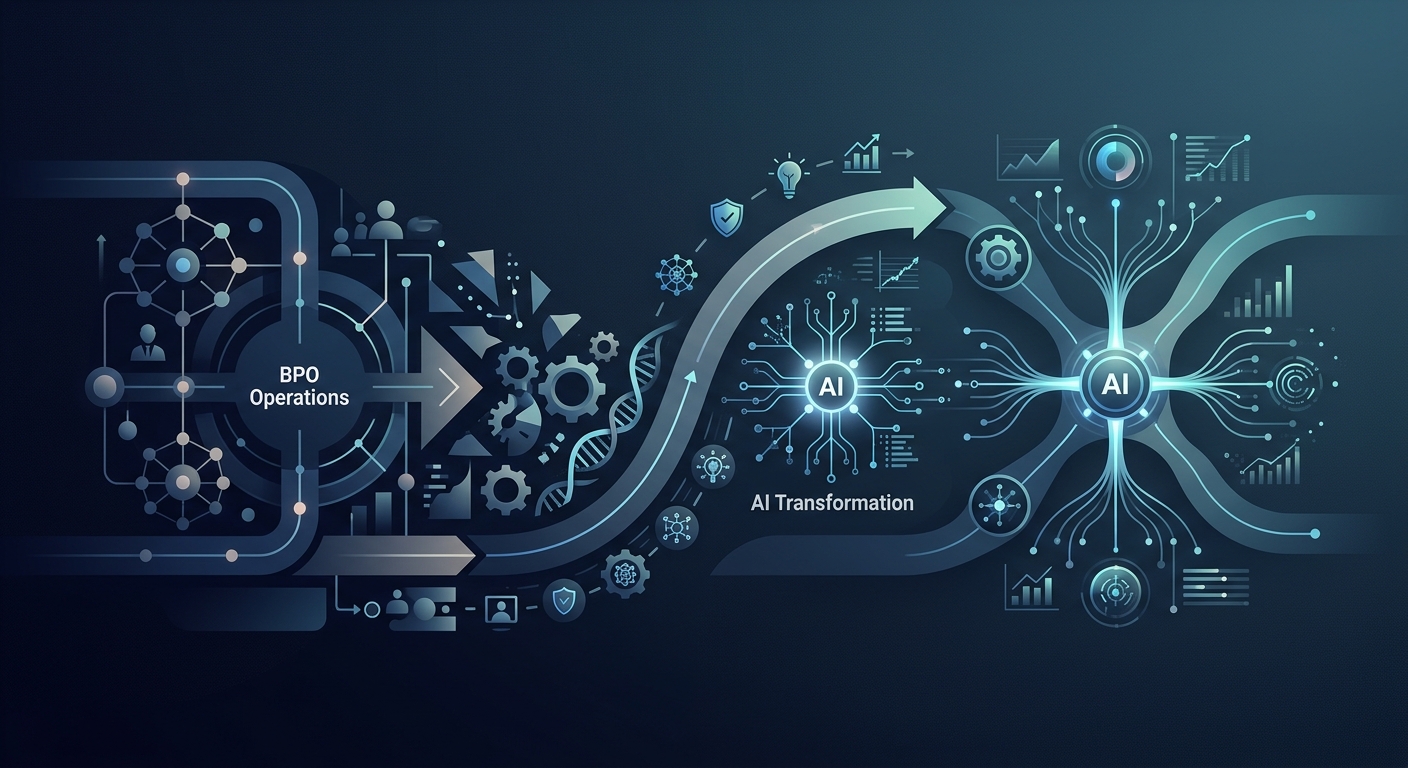
The traditional BPO model was engineered for a different era—one defined by labor arbitrage, fixed-capacity contracts, and linear scaling. That foundation is structurally misaligned with modern, agile operations. Replacing BPO with AI agents is not a speculative technology upgrade; it is a strategic operational restructuring. This shift replaces fixed-cost labor overhead with a scalable, outcome-driven workforce. High-performing enterprises no longer automate isolated tasks—they deploy an integrated AI infrastructure where every dollar directly correlates to verified business impact. This framework provides a disciplined, four-phase transition methodology, deterministic performance baselines, and a pay-for-performance pricing architecture to guarantee enterprise-grade ROI.
The Hidden Costs of Traditional BPO Models
Fixed retainer structures inherently mask operational inefficiencies. Multi-year, headcount-based contracts pay for seat availability rather than measurable outcomes. Organizations inevitably absorb the financial drag of idle capacity, continuous training attrition, and process drift. Traditional outsourcing also relies on linear scaling. Responding to demand spikes requires proportional headcount increases, creating operational bottlenecks, extended ramp-up times, and compounding management overhead. Industry analysis confirms the legacy BPO playbook—built on functional silos and cost arbitrage—cannot adapt to volatile markets or real-time operational demands. The result is a rigid cost structure that penalizes organizational agility and obscures true unit economics.
Why AI Agents Outperform Outsourced Workforces
AI agents eliminate human variability through deterministic execution and uninterrupted, 24/7 availability. Unlike shift-based teams constrained by fatigue, scheduling conflicts, and compliance drift, an autonomous workforce maintains consistent performance standards across every interaction, regardless of volume or complexity. This algorithmic reliability is critical in enterprise environments where strict process adherence directly impacts revenue capture and regulatory risk.
Furthermore, AI agents generate comprehensive, real-time audit trails and granular process telemetry. Subjective SLA reporting is replaced by objective, timestamped performance data. While human specialists remain essential for complex, empathy-driven scenarios, AI autonomously executes high-volume, rule-based workflows with zero degradation in quality. This shift from probabilistic human output to algorithmic certainty ensures scaling never compromises compliance or accuracy. Enterprises gain a fully transparent, auditable environment where every action is measurable and continuously optimized.
The Four-Phase BPO to Agent Transition Framework
Successfully migrating from outsourced labor to autonomous systems requires a disciplined methodology that prioritizes risk mitigation and operational continuity.
Phase 1: Process Deconstruction and Outcome Mapping. Isolate high-ROI, rule-based workflows from existing vendor contracts. Map every data input, decision node, and required output to establish unambiguous success criteria. Conduct a rigorous operational impact assessment to align internal roles and ensure seamless structural realignment.
Phase 2: Agent Architecture Design and Integration. Deploy targeted agent configurations compliant with enterprise security protocols and data governance standards. Establish secure API connectivity, validate data pipelines, and align strictly with Security, Compliance & Governance frameworks. Systems must integrate natively within existing IT stacks without destabilizing legacy infrastructure.
Phase 3: Parallel Execution and Human Oversight. Run agents in shadow mode alongside incumbent teams. This validation period establishes accuracy baselines, surfaces operational edge cases, and refines automated decision logic. Maintain continuous human oversight until performance consistently exceeds historical benchmarks, ensuring zero disruption during scale-up.
Phase 4: Full Operational Cutover and Continuous Optimization. Systematically retire legacy contracts as the AI workforce assumes primary execution. Implement automated feedback loops for real-time model refinement, enabling the system to adapt dynamically to evolving business rules and regulatory shifts. Follow our Implementation Methodology to enforce enterprise-grade deployment standards.
Executive Best Practices for Risk-Free Migration
Enterprise migration to an autonomous workforce demands uncompromising operational safeguards.
Implement Deterministic Fallback Protocols. Guarantee zero service disruption by instantly routing unscripted edge cases to human specialists when agent confidence falls below predefined thresholds. Operational resilience must remain non-negotiable throughout the transition lifecycle.
Establish Outcome-Based KPIs. Tie metrics directly to financial and operational performance. Discard vanity metrics like "tickets resolved" in favor of revenue retention, direct cost reduction percentages, and cycle-time acceleration. Linking autonomous performance to measurable business outcomes validates ROI & Performance Metrics in real time.
Execute Structured Change Management. Equip internal teams to leverage AI for strategic capacity expansion, not as a displacement threat. This metrics-driven, risk-averse approach converts migration uncertainty into predictable operational leverage.
The Pay-for-Performance Model: Aligning Cost with Results
The economic advantage of replacing BPO with AI is fully realized through outcome-based pricing. Traditional outsourcing locks enterprises into fixed OPEX, where costs remain static regardless of output quality, volume fluctuations, or vendor underperformance. A pay-for-performance AI model shifts financial exposure to the provider, triggering costs only when verified business impact occurs. This aligns vendor incentives directly with client profitability, eliminating the friction of traditional contract renegotiations.
Contractual accountability replaces expensive vendor management overhead. Enterprises operate with transparent, auditable metrics that dictate billing automatically. If agents miss predefined outcome thresholds, payment is withheld. This fundamentally redefines operational procurement, transforming AI deployment from a speculative capital outlay into a variable, outcome-priced utility. By adopting our Pay-for-Performance Model, organizations secure predictable cost structures while retaining the strategic flexibility to scale dynamically. The result is an AI workforce that funds itself through verified efficiency gains, margin expansion, and accelerated execution.
Next Steps: Operationalizing Your AI Workforce
Transitioning from fixed-cost outsourcing to an autonomous, outcome-driven infrastructure begins with a rigorous operational readiness audit. Catalog existing processes, identify high-volume workflows, and benchmark current unit costs against projected AI efficiencies. This diagnostic phase surfaces immediate deployment candidates capable of delivering rapid ROI.
Following the audit, launch a capped-risk pilot program. A time-bound deployment validates technical performance, stress-tests integrations, and secures executive alignment before committing enterprise-scale budgets. Start small, measure rigorously, and scale only upon verified success. Enterprises can systematically replace legacy outsourcing without operational disruption. The shift to AI-driven operations is a strategic imperative for scalable growth and predictable margins. Begin evaluating core workflows today to unlock the financial and operational leverage of an outcome-priced AI workforce.