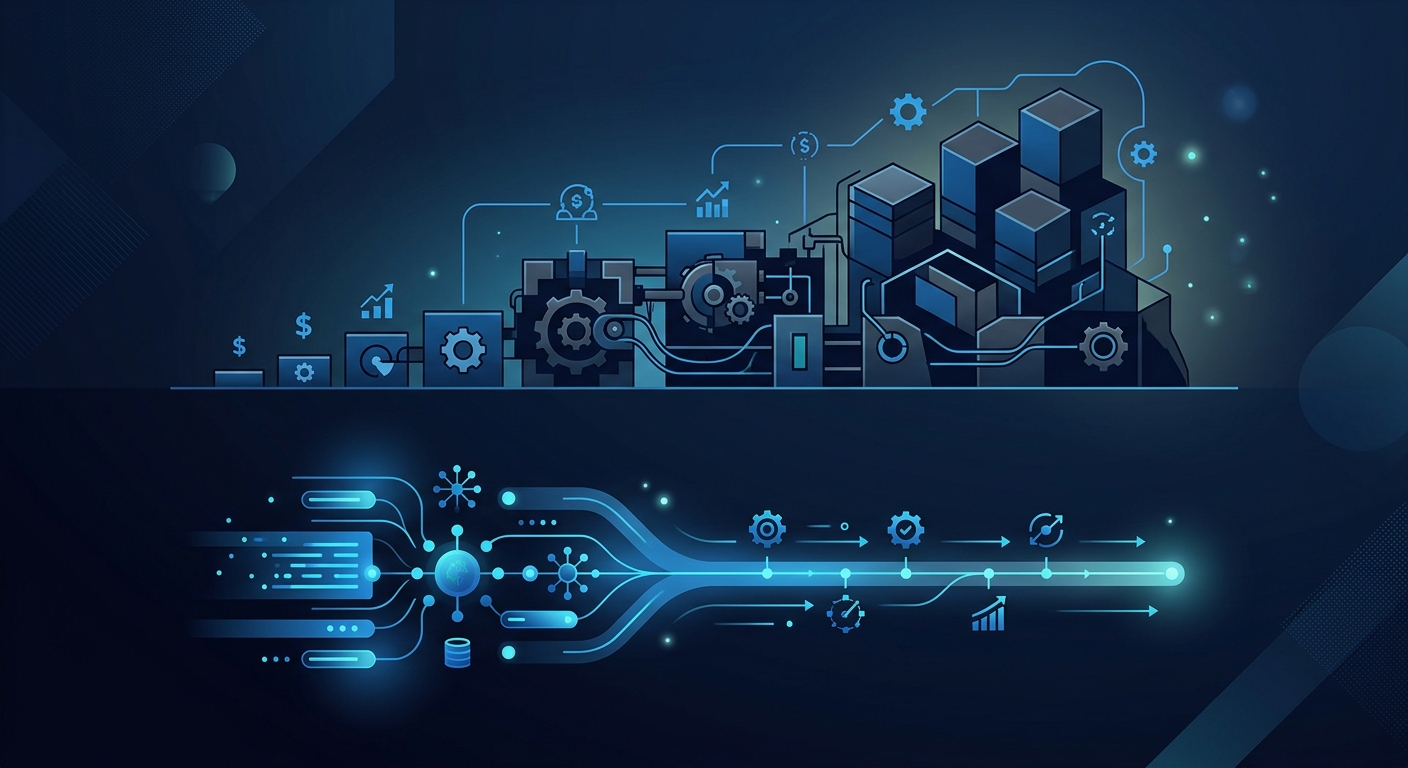
Traditional Total Cost of Ownership (TCO) models for enterprise automation are fundamentally misaligned with modern operational demands. They treat software procurement as a static capital expenditure while ignoring the compounding drag of rigid, rule-based infrastructure. As organizations evaluate legacy RPA vs AI agents, the economic reality is clear: legacy automation demands continuous human oversight, while AI agents operate autonomously. The strategic imperative is no longer purchasing tools; it is deploying a scalable, accountable digital workforce. By adopting pay-for-performance pricing, enterprises eliminate sunk licensing costs and directly align spend with verified business outcomes. This shifts automation from a speculative IT expense to a predictable, results-driven operational asset that compounds value across the enterprise and delivers up to 72% lower TCO than traditional deployments.
Legacy RPA TCO: The Hidden Maintenance Tax
Initial licensing and implementation fees for traditional RPA represent only a fraction of the true financial burden. Industry analyses show that multi-year maintenance, exception handling, and IT dependency routinely inflate lifecycle costs by over 300% AI Agents vs Traditional RPA: Which Wins the Automation Race?. Because legacy bots rely on static, rule-based workflows, any deviation in data format, UI layout, or business logic triggers immediate failure. This fragility creates a compounding maintenance tax. IT teams and process owners spend disproportionate time reconfiguring scripts, patching rule sets, and mitigating unplanned downtime.
Bot sprawl further accelerates this financial drain. Scaling static workflows requires linear increases in licensing, infrastructure, and dedicated support headcount. Organizations become trapped in a cycle where every new automation demands proportional administrative overhead. Traditional RPA deployments also require continuous manual intervention to manage edge cases, directly undermining projected labor displacement AI Agent vs Traditional RPA: Performance Comparison for 2025. When evaluating total cost of ownership automation, enterprises must price these hidden operational liabilities, which consistently erode ROI and stall scaling initiatives.
AI Agent TCO: Dynamic Scaling Without Linear Costs
AI agents decouple process complexity from cost structure. Unlike brittle rule sets, autonomous reasoning engines interpret context, adapt to unstructured data, and resolve novel exceptions without human escalation. This reduces exception management overhead by up to 90% compared to legacy frameworks AI Agent vs Traditional RPA: Performance Comparison for 2025. Where traditional bots break, AI agents self-optimize and maintain continuity across volatile workloads.
This architecture enables non-linear scalability. Increasing agent capacity does not require proportional infrastructure investment or compounding licensing fees. Enterprises transition from restrictive seat-based or bot-count models to workload-based consumption aligned with actual output. Agents handle 10x more process variations without reconfiguration, allowing organizations to absorb demand spikes or expand to adjacent functions without vendor renegotiation AI Agent vs RPA Bot: Complete Cost & Speed Comparison for Enterprise Decision-Makers. By treating AI agents as elastic resources rather than fixed software assets, enterprises establish a leaner AI cost comparison model that prioritizes throughput and outcome delivery over tool proliferation.
Pay-for-Performance vs. Fixed Licensing: Risk Transfer
The most significant financial advantage of modern agentic deployment lies in commercial alignment. Traditional vendors profit from prolonged implementation cycles and recurring licensing fees, effectively shifting execution risk to the buyer. Meo’s Pay-for-Performance Model reverses this dynamic. Enterprises pay only when agents deliver verified, measurable outcomes—transferring implementation, operational, and adoption risk entirely to the provider.
This model shifts automation procurement from fixed CapEx to variable OpEx directly tied to business impact. Financial leadership tracks auditable metrics: throughput acceleration, error reduction, and verified labor displacement. With contractually enforced performance guarantees, automation spend becomes self-funding. Enterprises no longer budget for projected efficiencies; they pay exclusively for realized capacity. This accountability framework guarantees that every dollar deployed drives measurable bottom-line impact, transforming enterprise AI agent ROI into a predictable, outcome-driven workforce strategy.
Using the Agent ROI Calculator to Model Business Impact
Accurate financial forecasting requires models grounded in operational reality. A robust agent ROI calculator must move beyond simplistic license-versus-salary comparisons. It must factor in adoption curves, monitoring overhead, and real-world exception costs AI Agent ROI Calculator: How to Measure the Business Impact of AI .... Key inputs include current headcount expenses, legacy RPA maintenance spend, monthly exception volumes, and process complexity tiers. Quantifying these variables reveals the true cost delta of transitioning to an agentic workforce.
The resulting projections deliver actionable financial benchmarks: compressed payback timelines, annualized ROI, and three-year TCO improvements. Independent analyses show AI agents achieve an average 4.3-month payback, compared to 18–24 months for traditional RPA AI Agents vs Traditional RPA: Which Wins the Automation Race?. To translate these metrics into a board-ready business case, align technical projections with strategic financial targets. Use our modeling tools to stress-test assumptions, validate cost projections, and secure executive approval prior to deployment.
Execution Path: From Cost Analysis to Scalable Deployment
Transitioning from legacy infrastructure to an agentic operating model requires a disciplined, phased approach. Start with targeted, outcome-priced pilots that validate cost assumptions against live production workloads. This de-risks the migration while generating real-world data to refine your total cost of ownership automation model.
Successful deployment follows a structured Implementation Methodology that prioritizes high-impact, high-complexity workflows to accelerate early ROI. Continuous optimization loops ensure agents scale as an accountable workforce, not a static software license. By embedding compliance guardrails, performance monitoring, and iterative refinement, enterprises maintain operational transparency and compound efficiency gains. The result is a resilient, self-optimizing ecosystem designed for long-term scale.
Conclusion
The financial case for agentic AI is no longer speculative—it is mathematically validated. Replacing rigid legacy bots with adaptive, reasoning-driven agents eliminates the hidden maintenance tax of traditional automation and unlocks non-linear scalability. Through a strict pay-for-performance framework, meo ties fees to verified operational outcomes.
Stop funding speculative software licenses. Start investing in a measurable, accountable workforce. Run your AI Workforce ROI Calculator or schedule a strategic deployment assessment to quantify your exact cost-to-value delta and scale with confidence.